

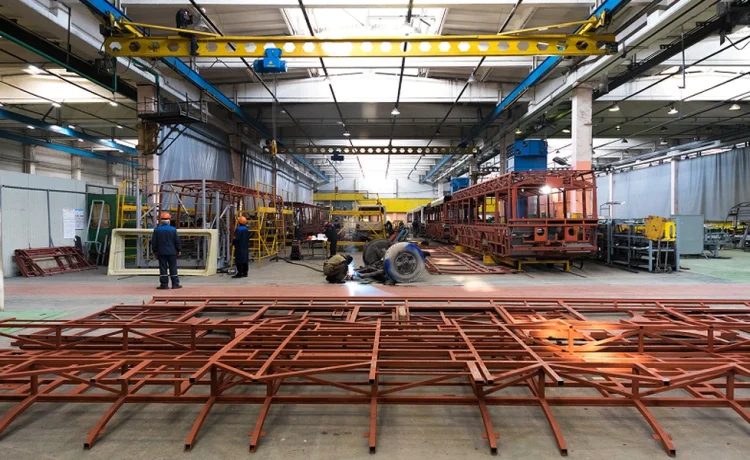

Image Recommendation: An industrial casting or forging facility floor with finished metal automotive or infrastructure components ready for shipment.
By the time a project team is actively searching for a parts supplier, the timeline usually doesn’t have much slack left in it. Lead times for speciality alloys, certified castings, and precision-formed components are measured in weeks or months, not days, which means the search that matters most often starts long before anyone admits a current supplier isn’t going to work out.
What Counts as Infrastructure Solutions in Singapore
The phrase infrastructure solutions in Singapore covers more ground than roads and buildings. Power transmission, rail systems, and the industrial plants that keep both running all depend on materials engineered to handle decades of continuous stress, not just the load they’re rated for on day one. Proterial, known as Hitachi Metals until its 2023 rename, has supplied into this category for most of a century, with its Singapore entity on record since 1979, well before much of the region’s current infrastructure existed in its present form.
A Materials Group Built Through a Century of Acquisitions
The company’s current product range didn’t appear all at once. Its origins trace to a 1910 foundry making malleable iron castings, which became Hitachi Metals Industries in 1956. Later additions brought in cable materials through a 2013 merger with Hitachi Cable, superalloys and cast components through the acquisitions of MMC Superalloy and the US foundry operator Waupaca, and tool steel distribution through a separate US acquisition. Each addition filled a specific gap, rather than duplicating what the group already made.
That acquisition history matters practically because it means a single supplier relationship can often cover several material categories that would otherwise require separate vendors, fewer handoffs between suppliers tends to mean fewer places for a specification to get lost in translation.
What a Parts Manufacturing Company Supplies That Isn’t Obvious
Beyond the finished component itself, a serious parts manufacturing company is also supplying the testing data, certification trail, and production history that let an engineering team sign off on a part without re-verifying everything from scratch. For automotive and heavy-infrastructure components specifically, that paper trail often matters as much as the metal itself, since regulators and OEM quality teams generally won’t accept a part on reputation alone.
Where the Automotive Side of the Business Is Shifting
Electric vehicle platforms have pushed magnet suppliers toward a specific problem: heavy rare earth elements like dysprosium are expensive and geographically concentrated in supply. Proterial has developed neodymium magnets for EV drive motors designed to reduce or eliminate dependence on those heavy rare earth additions, while a related soft magnetic material targets the motor cores that work alongside those magnets. For buyers specifying automotive components today, that shift is less a future consideration than a current sourcing question, since dependence on a single rare earth supply chain is exactly the kind of risk procurement teams are now paid to avoid.
What this means in practice is that a motor design locked in two or three years ago may already be specifying a magnet formulation that newer alternatives have since improved on, sometimes at a lower total cost once supply risk is priced in. Revisiting that specification isn’t automatically worth the engineering time it takes, but for a platform with years of production life still ahead of it, it’s usually worth at least asking the question rather than assuming the original choice still holds.
Why Qualification Timelines Run Longer for Infrastructure Parts
A component going into a rail system or a power substation generally faces a longer, more documented approval process than one going into a consumer product, and for good reason: a failure years into service is far costlier to trace and fix once it’s buried inside installed infrastructure. That extra scrutiny shows up as longer qualification timelines, sometimes six months or more for a new material entering a safety-critical application, and project teams that don’t budget for that window upfront are usually the ones scrambling to compress it later.
Working with a supplier that already has qualification data from similar projects, rather than starting that documentation from zero, is often the single biggest lever for shortening this stage without cutting corners on the testing itself.
Quick Translation: What Infrastructure Materials Really Mean
- Rated load capacity, the maximum stress a material is certified to handle
- Fatigue life, how many stress cycles it survives before failure risk rises
- Thermal stability, whether its properties hold steady across temperature swings
- Traceability, the documented production history behind a specific batch
None of these terms are exotic once they’re translated out of spec-sheet language, but a project team that doesn’t ask about all four, especially traceability, is usually only seeing part of what they’re actually buying, and finding that out mid-project is a far more expensive lesson than asking upfront.
| Project type | Priority property | Typical risk if overlooked |
| Rail or power infrastructure | Long-term fatigue life | Premature part failure under cyclic load |
| EV drivetrain components | Magnetic performance per gram | Oversized or underperforming motor |
| General automotive castings | Batch-to-batch consistency | Failed quality audits downstream |
A supplier search that only starts once a current one has already fallen through tends to produce rushed decisions on exactly the properties a spec sheet doesn’t make obvious at a glance, fatigue life and traceability chief among them. Contact Proterial Asia Pacific before that point arrives, not after.